


Normally Closed vs Normally Open Electro-thermal Actuators
Electro-thermal actuators are small components, but they have a direct impact on room-by-room heating control.
In a water underfloor heating system, each heating loop usually needs an actuator to open or close the valve on the manifold. When the room thermostat calls for heating, the actuator responds and allows water to flow into that zone.
For buyers, installers and heating product distributors, one of the most common questions is:
Should I choose a Normally Closed actuator or a Normally Open actuator?
The answer depends on one key point:
What should the valve do when there is no power?
This difference affects system safety, control logic, power-failure behavior and installation suitability.
However, NC or NO is not the only specification that matters. Buyers must also check:
- Operating voltage
- Thread size
- Manifold valve structure
- Valve stem height
- Required closing position
- Cable length
- Wiring center compatibility
MENRED offers actuator and valve products for heating and cooling applications.
You can view the product category here:
What Does “Normally Closed” Mean?
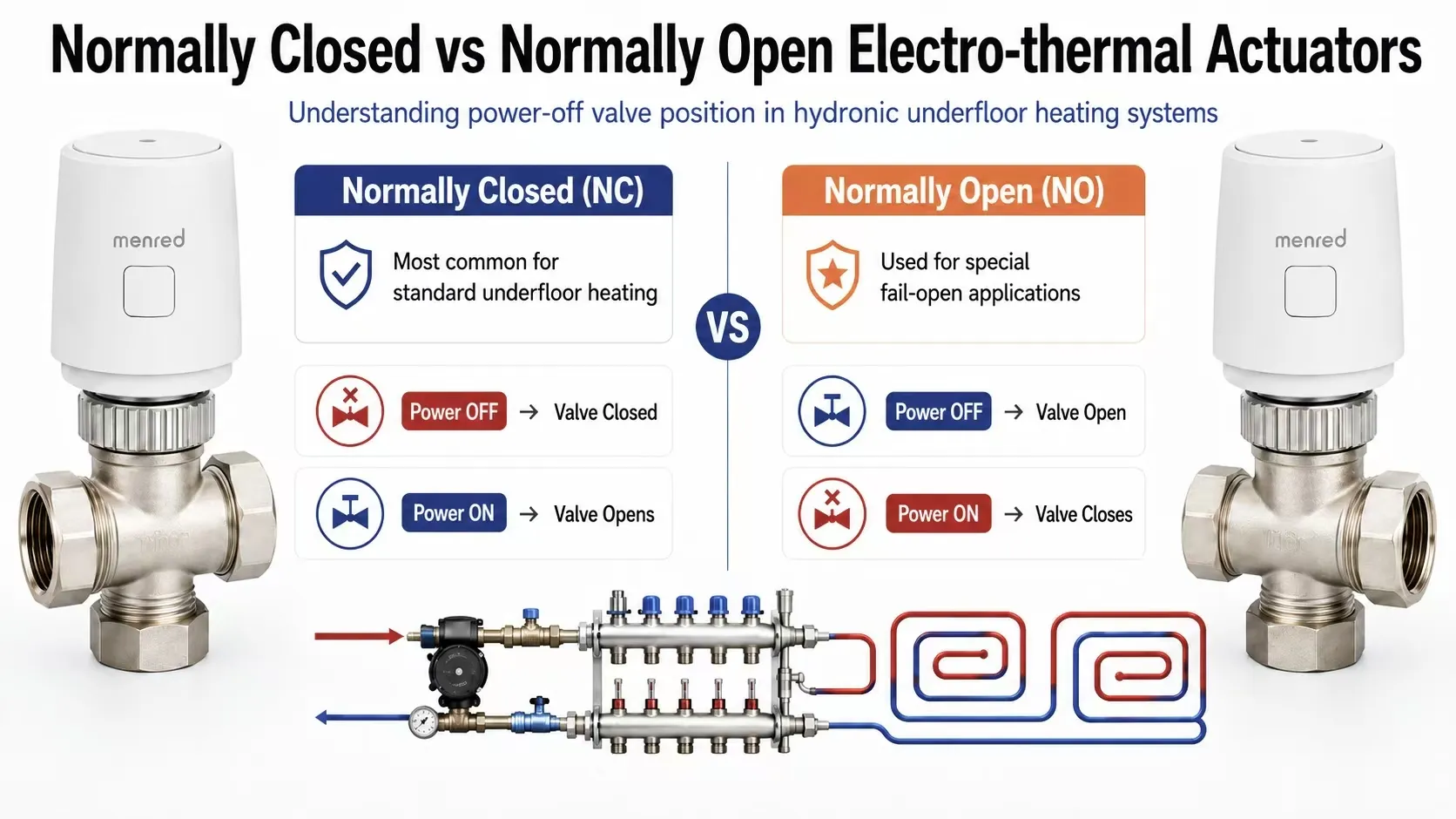
A Normally Closed electro-thermal actuator, often identified as NC, means that the valve remains closed when the actuator has no power.
When the thermostat sends a heating signal, the actuator receives power. The internal thermal element heats up, expands and gradually operates the valve.
Warm water can then flow into the underfloor heating loop.
When the room reaches the set temperature, the thermostat cuts the power. The actuator cools down and the valve returns to its closed position.
In simple terms:
NC = no power, no water flow.
This is why NC actuators are commonly used in residential underfloor heating systems.
The system only opens a heating loop when the corresponding room requires heat. For apartments, villas and normal residential manifold control, this is usually the most practical control method.
What Does “Normally Open” Mean?
A Normally Open electro-thermal actuator, usually identified as NO, works in the opposite way.
When there is no power, the valve remains open. When the actuator receives power, it operates the valve toward the closed position.
In simple terms:
NO = no power, water flow remains open.
This type is less common in standard residential underfloor heating systems, but it can be useful in projects that require water circulation to continue during a power failure.
However, NO actuators should not be selected accidentally.
If a system is designed for NC operation but an NO actuator is installed, the heating loop may work in the opposite way from what the thermostat expects.
This can cause:
- Unwanted heating
- Continuous water circulation
- Inaccurate room temperature control
- Higher energy consumption
- Confusion during installation and troubleshooting
NC vs NO Electro-thermal Actuator s: Main Difference
The main difference is not the external appearance.
NC and NO actuators may look almost identical. Their actual difference is the default valve position when power is removed.
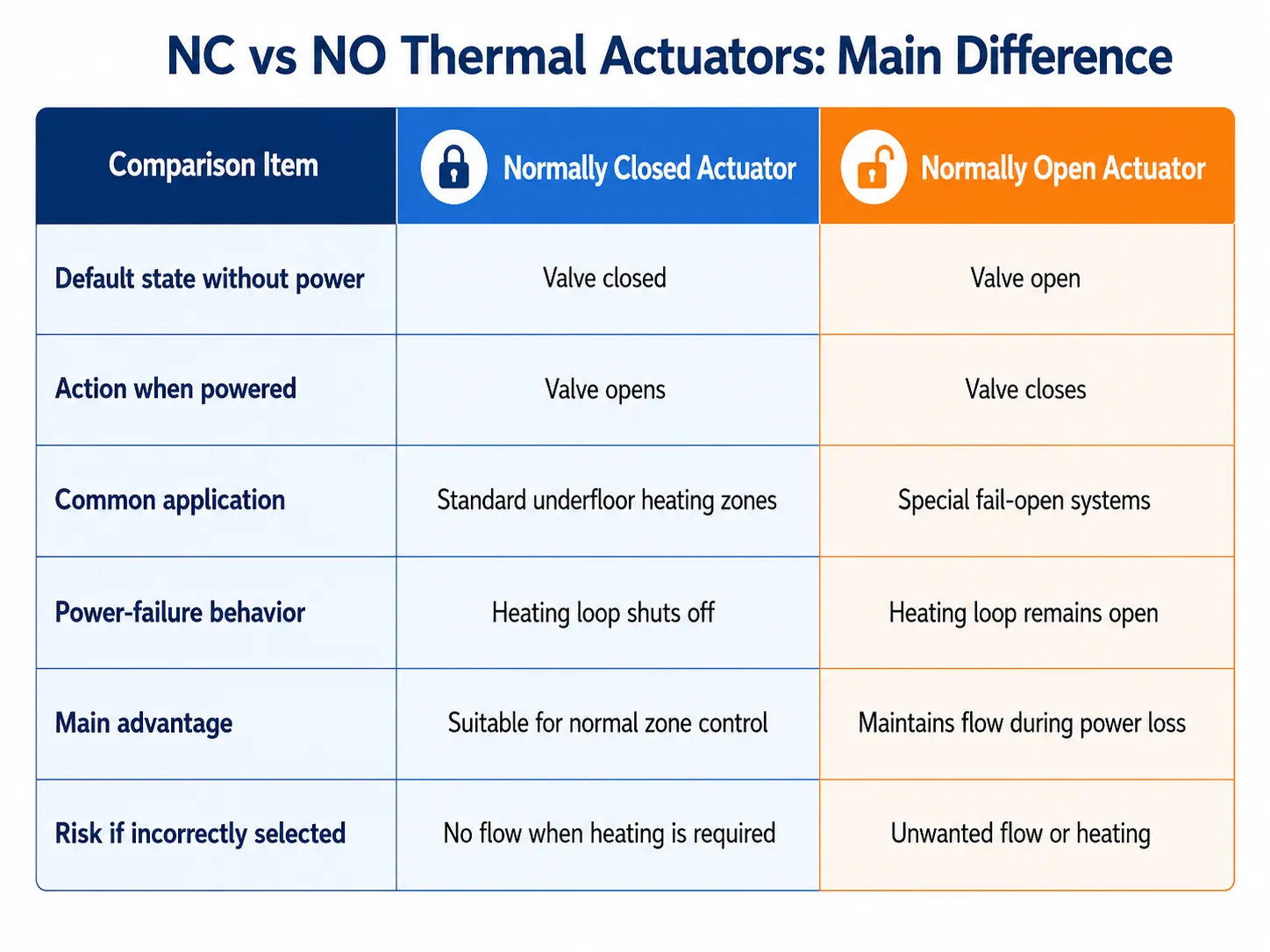
For most heating distributors, this table provides a simple way to explain the difference to customers.
For a standard floor heating manifold controlled by room thermostats, NC is normally the first option to consider.
NO should only be selected when the project specifically requires fail-open operation.
Which Type Is More Common in Underfloor Heating?
For standard residential underfloor heating systems, Normally Closed actuators are more common.
The reason is practical.
Heating is not required in every room all the time. The actuator should only open a heating loop when the room thermostat calls for heat.
Once the room reaches the selected temperature, the actuator should close the loop and stop the water flow.
This makes NC actuators suitable for:
- Apartments
- Villas
- Residential floor heating systems
- Manifold zone control
- Thermostat and actuator systems
- Thermostat, actuator and wiring center packages
- Standard heating-only applications
For distributors, NC actuators are also easier to stock and explain.
In many markets, buyers expect the actuator to remain closed without power unless another operating logic is specifically requested.
When Should You Choose Normally Open?
Normally Open actuators are not better or worse than Normally Closed actuators.
They are designed for a different control logic.
NO actuators may be considered when a project requires:
- Water circulation to continue during a power failure
- A fail-open system design
- Special freeze-protection logic
- Specific heating or cooling hydraulic control
- A control panel designed for NO operation
- A project specification that explicitly requires NO actuators
For example, a system designer may decide that a particular circuit should not close completely during an electrical fault.
In this situation, a Normally Open actuator may provide the required default valve position.
However, NO is normally not the default option for residential underfloor heating.
When project drawings or control specifications do not clearly require NO, the operating logic should be confirmed before ordering.
Power Failure Behavior: Why It Matters
Power-off behavior is the most important reason to distinguish NC from NO.
With a Normally Closed actuator, a power failure causes the valve to return to its closed position.
This helps prevent uncontrolled water flow. For most residential systems, this is acceptable because the thermostat, pump and heat source may also stop operating when electrical power is lost.
With a Normally Open actuator, the valve remains open during a power failure.
This may be useful for maintaining circulation, but it can also cause unwanted heating if the pump or heat source continues to operate.
From a buyer’s perspective, actuator selection is therefore not only a product decision. It is part of the complete system design.
Before confirming NC or NO, check:
- Thermostat output logic
- Wiring center design
- Pump control logic
- Manifold valve type
- Project safety requirements
- Required power-failure behavior
Correct selection at the quotation stage can prevent installation problems and after-sales claims.
How MENRED Identifies NC and NO Actuators
MENRED uses a straightforward identification method for Normally Closed and Normally Open electro-thermal actuators.
For standard Normally Closed models, “NC” is generally not printed separately on the actuator because NC is the default configuration.
For Normally Open models, “NO” is specifically marked on the actuator or product identification.
This helps distributors, installers and warehouse staff distinguish NO models from the standard NC version.
The current MENRED product situation is:
- Some older models still exist in Normally Open versions
- Some older models are available with 24V operating voltage
- Current new actuator models are mainly Normally Closed
- Current new actuator models are mainly 220V
This is especially important when replacing actuators in existing underfloor heating systems.
An older 24V or Normally Open actuator should not be replaced directly with a new 220V Normally Closed model without checking:
- Thermostat output voltage
- Wiring center output voltage
- Existing control logic
- Manifold valve structure
- Thread size
- Valve stem dimensions
For OEM and private-label orders, the actuator marking, model number, voltage information and packaging identification should be confirmed before production.
Operating Voltage: 220V and Legacy 24V Models
The actuator voltage must match the output voltage of the thermostat or wiring center.
A 24V actuator cannot be connected directly to a 220V control output. A 220V actuator must also not be connected to a 24V control system.
Incorrect voltage selection may:
- Prevent the actuator from operating
- Damage the actuator
- Damage the control output
- Create system troubleshooting problems
- Cause an incorrect replacement order
For a complete underfloor heating control system, the following components must use compatible voltages:
- Room thermostat
- Wiring center
- electro-thermal actuator
- Pump or boiler control module
- Transformer, when required
For replacement projects, buyers should provide the old actuator model, operating voltage and product label before ordering.
Thread and Manifold Compatibility
Electro-thermal actuators are installed on the valve inserts of underfloor heating manifolds.
A commonly used connection is M30 × 1.5, but buyers should not assume that every manifold uses the same thread or valve structure.
Thread compatibility determines whether the actuator can be physically installed on the manifold.
However, a matching thread does not automatically guarantee correct operation.
Two actuators may both use an M30 × 1.5 connection but still have different compatibility because of differences in:
- Valve stem height
- Mounting reference surface
- Closing position
- Opening position
- Valve stem travel
- Actuator internal structure
- Required closing force
This is why valve stem dimensions must be considered together with thread size.
Actuator Stroke and Valve Closing Dimension: Why 11 mm Matters
When selecting an electro-thermal actuator, buyers should not only ask about the nominal actuator stroke.
The more important question is:
Can the actuator press the manifold valve stem far enough to close the valve completely?
To evaluate this, first identify the mounting reference surface where the actuator sits against the manifold valve.
All valve stem height measurements should be taken from the same mounting reference surface.
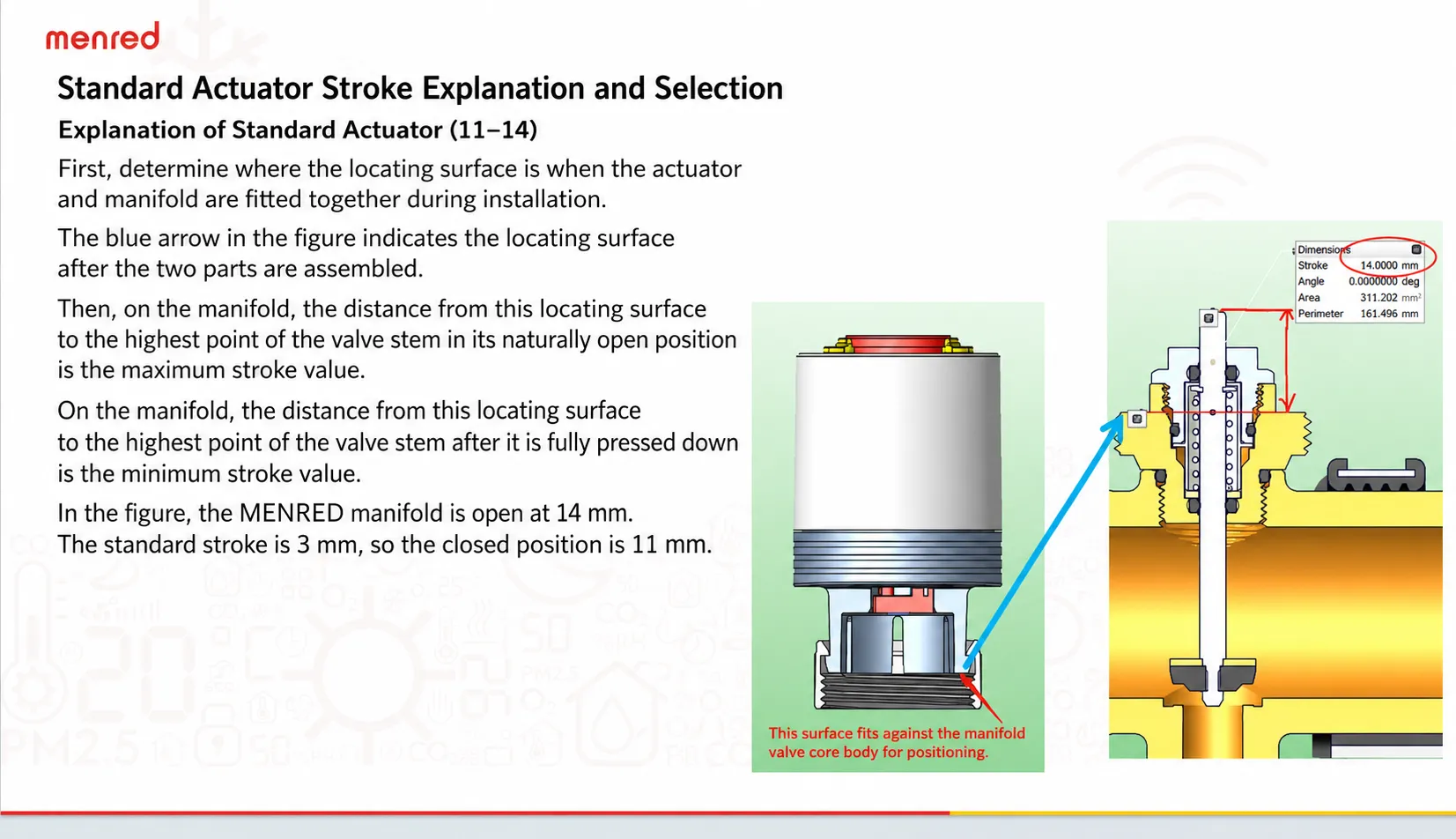
For the MENRED manifold shown in the diagram:
- The distance from the mounting reference surface to the top of the valve stem in its naturally open position is approximately 14 mm
- The distance from the same mounting surface to the top of the valve stem when it is fully pressed and the valve is closed is approximately 11 mm
- The actual movement of the valve stem between the open and closed positions is approximately 3 mm
It is important to understand that 11–14 mm does not mean that the actuator itself has an 11–14 mm mechanical stroke.
Instead, it describes the valve stem position measured from the mounting reference surface.
The actuator needs to match this valve stem position range and must be capable of pressing the stem down to the required closing point.
Why the 11 mm Closing Position Is More Important
For practical compatibility, the most important dimension is the 11 mm closing position.
The actuator must be able to press the valve stem down to this position so that the valve can close completely.
If the actuator cannot reach the required closing point, the valve may remain partially open.
This can result in:
- Unwanted water circulation
- Heating continuing after the thermostat has stopped calling for heat
- Room temperature overshoot
- Higher energy consumption
- Poor zone control
- Difficulty balancing the underfloor heating system
- Customer complaints about rooms remaining too warm
The upper opening dimension is normally less critical.
A slightly larger opening allowance generally does not negatively affect normal use, provided that:
- The actuator is installed correctly
- The thread is compatible
- The actuator is properly seated
- The valve structure is suitable
- The mechanical limits are not exceeded
MENRED’s earlier actuator designs were generally compatible with valve stem height ranges of approximately 11–14 mm.
Current actuator designs have extended the upper compatibility range to approximately 11–15 mm or greater.
The critical closing position remains approximately 11 mm, while the increased upper opening allowance improves compatibility with a wider variety of manifold valves in different markets.
This wider range is useful for:
- Distributors sourcing manifolds from different suppliers
- OEM customers combining MENRED actuators with their own manifolds
- Replacement projects
- Heating system integrators
- Markets with several manifold valve standards
Stroke Compatibility Checklist
Before ordering an electro-thermal actuator, confirm the following information:
- Valve stem height in the naturally open position
- Valve stem height in the fully closed position
- Required valve stem travel
- Mounting reference surface
- Thread size
- Connection type
- Required actuator closing force
- Normally Closed or Normally Open operation
- Operating voltage
- Available installation space
A matching thread alone does not guarantee correct operation.
Even when the actuator and manifold both use M30 × 1.5 connections, differences in valve stem height or closing position may prevent the valve from closing correctly.
A professional actuator quotation should therefore include:
- Actuator type: NC or NO
- Operating voltage
- Thread size
- Compatible valve stem dimensions
- Cable length
- Protection rating
- Compatible manifold or valve type
- Required quantity
How to Choose: A Simple Buyer Guide
For standard water underfloor heating systems, buyers can start with the following selection logic.
Choose Normally Closed if:
- The project is a standard residential heating system
- Each room is controlled by a thermostat
- The valve should close when power is off
- The wiring center is designed for NC actuators
- A common stock model is required
- No special fail-open requirement exists
Choose Normally Open if:
- The system must maintain flow during a power failure
- The project requires fail-open operation
- The control panel is specifically designed for NO actuators
- The designer has confirmed NO control logic
- The application is not a standard residential heating loop
For most distributors, the safer stock strategy is to keep NC as the standard model and treat NO as a project-specific option.
However, NC or NO alone is not enough.
Before confirming an actuator model, the buyer should ask:
- NC or NO?
- 220V or 24V?
- What thread size?
- What is the valve stem opening height?
- What is the required closing position?
- Which manifold will be used?
Common Mistakes When Buying Electro-thermal Actuator s
Mistake 1: Only Asking for Price
Electro-thermal actuators look simple, so some buyers compare only the unit price.
This can be risky.
A lower-priced actuator with the wrong voltage, thread, valve stem compatibility or control logic may create much higher installation and after-sales costs.
Mistake 2: Confusing NC and NO
NC and NO use opposite control logic.
If the wrong type is installed, the room thermostat may appear to work incorrectly even when the thermostat and wiring are functioning normally.
Mistake 3: Ignoring the 11 mm Closing Position
Some buyers only check the opening height or nominal stroke.
However, the critical question is whether the actuator can press the valve stem down far enough to fully close the valve.
For the MENRED manifold illustrated above, the critical closing position is approximately 11 mm from the mounting reference surface.
Mistake 4: Assuming the Same Thread Means Full Compatibility
Two products may both use an M30 × 1.5 connection but have different valve stem heights or closing requirements.
The actuator may fit physically but still fail to close the valve completely.
Mistake 5: Not Checking Wiring Center Output
A wiring center designed for a 220V actuator should not be connected randomly to a 24V actuator.
The control voltage must be confirmed before ordering.
Mistake 6: Replacing an Old Model Without Checking Its Specifications
Older MENRED projects may use:
- Normally Open actuators
- 24V actuators
- Earlier valve stem compatibility ranges
Current new MENRED actuator models are mainly NC and 220V.
The old model should therefore be checked before ordering a replacement.
Mistake 7: Unclear Product Labeling
For MENRED standard products, NC is the default configuration and may not be marked separately.
NO products are specially marked.
Distributors should make sure that the following information is clearly shown on the product label, carton or warehouse record:
- Model number
- NC or NO
- Operating voltage
- Thread size
- Cable specification
This reduces warehouse, installation and replacement mistakes.
MENRED Product Fit for Distributors and HVAC Buyers
Electro-thermal actuators are usually not purchased as isolated products.
They are commonly sold together with:
- Room thermostats
- WiFi thermostats
- Wiring centers
- Underfloor heating manifolds
- Pump and boiler control modules
- Floor sensors
- Mixing groups
- Other underfloor heating accessories
This gives heating distributors the opportunity to build a more complete underfloor heating control product range.
MENRED’s current new actuator range focuses mainly on:
- 220V operation
- Normally Closed control
- Residential underfloor heating applications
- Manifold zone control
- Thermostat and wiring center systems
Compared with earlier models designed around approximately 11–14 mm valve stem height compatibility, newer MENRED actuator designs extend the upper compatibility range to approximately 11–15 mm or greater.
The critical closing position remains approximately 11 mm.
The increased upper opening allowance improves compatibility with manifold valves from different suppliers and markets.
Legacy Normally Open and 24V models may still exist in older projects or selected product ranges.
For replacement orders, buyers should provide:
- Old actuator model
- Product label photo
- Voltage
- NC or NO type
- Thread size
- Manifold model
- Valve stem opening height
- Valve stem closing height
MENRED can also support selected OEM requirements, including:
- Customer logo
- Product labels
- Model identification
- Packaging
- Instruction manuals
- Product specifications
View MENRED Actuators and Valve
FAQ
1. Is Normally Closed Better Than Normally Open?
For most residential underfloor heating systems, Normally Closed is usually the more practical default choice.
It keeps the valve closed when power is off and opens the heating loop only when the room thermostat calls for heat.
Normally Open is more suitable when the project specifically requires fail-open operation.
2. What Happens When a Normally Closed Actuator Loses Power?
The actuator returns to its default position and the valve closes.
This stops water flow through the corresponding heating loop.
3. What Happens When a Normally Open Actuator Loses Power?
The valve remains open.
This can be useful in special systems, but it may create unwanted water circulation if the rest of the system is not designed for NO control.
4. Can NC and NO Actuators Be Used on the Same Manifold?
It may be physically possible when the connections are compatible, but it is generally not recommended unless the control system is specifically designed for mixed operating logic.
Mixing NC and NO actuators without clear planning can confuse installers and create control problems.
5. What Does 11–14 mm Mean?
It refers to the valve stem position measured from the actuator mounting reference surface.
For the illustrated MENRED manifold:
- Approximately 14 mm is the naturally open valve stem position
- Approximately 11 mm is the fully closed valve stem position
- The actual valve stem movement is approximately 3 mm
It does not mean that the actuator itself has an 11–14 mm mechanical stroke.
6. Why Is the 11 mm Dimension Important?
The 11 mm position is the critical closing point.
The actuator must press the valve stem down to this position to close the valve completely.
If the actuator cannot reach it, the valve may remain partially open and allow unwanted water circulation.
7. Does a Larger Opening Range Cause a Problem?
A larger upper opening allowance normally does not affect use, provided that the actuator is correctly installed and compatible with the manifold valve.
This is why newer MENRED designs have increased the upper compatibility range from approximately 14 mm to 15 mm or greater.
8. How Are MENRED NC and NO Actuators Marked?
NC is the standard MENRED configuration and may not be marked separately.
NO models are specifically marked to distinguish them from the default NC version.
9. Are MENRED Actuators 220V or 24V?
Current new MENRED actuator models are mainly 220V Normally Closed versions.
Some older models are still available or installed as 24V or Normally Open versions.
The exact model should be confirmed before ordering or replacing an actuator.
10. What Information Should I Provide Before Buying Actuators?
Buyers should confirm:
- NC or NO
- Operating voltage
- Thread size
- Valve stem opening height
- Valve stem closing height
- Manifold model
- Cable length
- Required quantity
For OEM orders, buyers should also confirm logo, label, packaging and instruction manual requirements.
Final Recommendation
For most standard residential underfloor heating systems, Normally Closed Electro-thermal actuators are the practical first choice.
They match common room thermostat control logic, close the valve when power is removed and are easier for distributors to stock and explain.
Normally Open actuators should be selected only when a project specifically requires fail-open behavior.
However, choosing the correct actuator involves more than deciding between NC and NO.
Buyers must also confirm:
- Operating voltage
- Thread size
- Valve stem height
- Critical closing position
- Manifold compatibility
- Wiring center output
- Required power-failure behavior
For manifold compatibility, the closing dimension is particularly important.
In the MENRED example, the actuator must be able to reach the approximately 11 mm closing position. A larger upper opening allowance generally does not affect normal use and can improve compatibility with different manifold valves.
The best actuator is therefore not simply an NC or NO model.
It is the actuator that correctly matches the project’s control logic, operating voltage, manifold connection and valve stem dimensions.