


Flow Balancing: The Key to an Efficient Hydronic Floor-Heating System
Introduction
A well-designed hydronic floor-heating system should provide comfortable temperatures, efficient energy use, and stable operation throughout the building. However, even when high-quality components such as heat pumps, pipes, manifolds, and thermostats are installed correctly, some systems still experience uneven heating performance.
Typical complaints include:
- Some rooms becoming too warm while others remain cold
- Slow heating response in certain areas
- Increased energy consumption
- Heat pumps operating inefficiently
In many cases, the problem is not the heat source or the heating pipe itself, but incorrect water flow distribution between heating circuits.
This is where flow balancing becomes essential.
In European hydronic floor-heating design practices, each heating circuit should be adjusted according to its required flow rate to achieve the designed heat output and maintain consistent indoor comfort. Proper hydraulic balancing ensures that every room receives the correct amount of heat instead of allowing water to flow unevenly through the system.
What Is Flow Balancing in Hydronic Floor Heating?
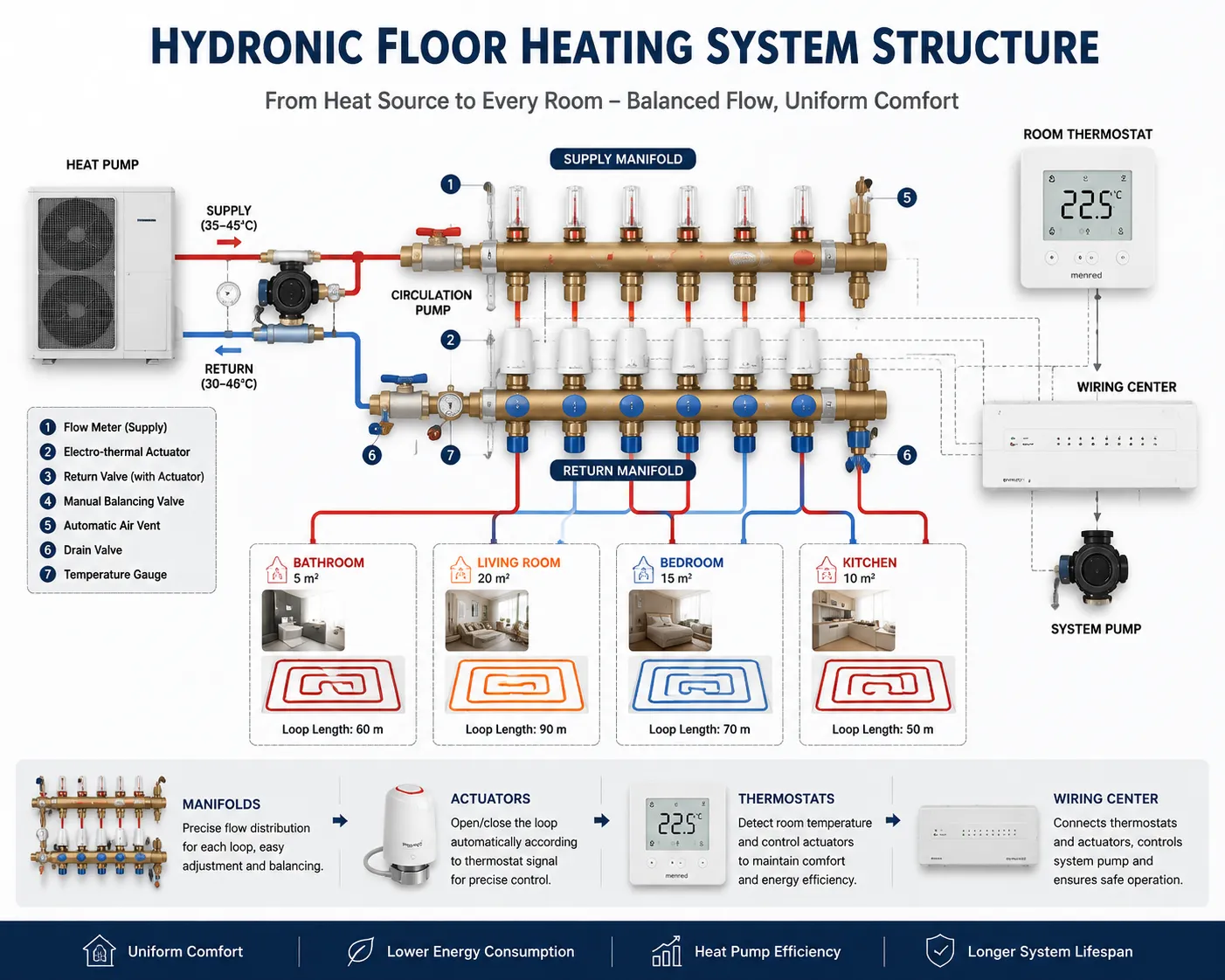
A hydronic floor-heating system transfers heat through warm water circulating inside pipes installed below the floor surface.
The basic process is:
Heat Source
↓
Circulation Pump
↓
Manifold
↓
Multiple Heating Loops
↓
Room Heat Distribution
Each heating loop has different hydraulic characteristics.
Factors affecting flow resistance include:
- Pipe length
- Number of bends
- Circuit design
- Pipe diameter
- Required heating output
- Room heat demand
For example, a bathroom loop may only require a shorter pipe circuit, while a living room with a larger floor area may require a longer loop.
Without proper adjustment, water naturally prefers the path with lower resistance. Shorter circuits may receive excessive flow, while longer circuits may not receive enough hot water.
As a result, the system may operate, but the comfort level and efficiency will not reach the designed performance.
Why Flow Balance Matters for Underfloor Heating Performance
Unlike traditional radiators, underfloor heating systems operate with large heat transfer areas and relatively low water temperatures.
This makes correct water distribution especially important.
1. Prevent Uneven Room Temperatures
One of the most common problems in hydronic floor heating is uneven comfort.
For example:
- Bathroom: Too warm
- Bedroom: Too cold
- Living room: Slow temperature increase
The reason is often an unbalanced system.
A short heating circuit may receive more water flow than required, causing excessive heat output. Meanwhile, a longer circuit may not receive sufficient circulation, reducing heating performance.
By adjusting each circuit according to the required flow rate, every room can receive a more suitable amount of heat.
2. Improve Heat Pump Efficiency
Modern buildings increasingly use heat pumps together with radiant heating systems because they can operate efficiently at lower water temperatures.
However, heat pump performance depends on stable system circulation.
Poor flow distribution can cause:
- Frequent heat pump cycling
- Longer operating periods
- Reduced seasonal efficiency
- Unnecessary energy consumption
A properly balanced hydronic system allows the heat pump to operate under more stable conditions by maintaining suitable flow rates and heat transfer.
This is especially important in low-temperature heating applications where system optimization directly affects overall efficiency.
How to Balance a Hydronic Floor Heating System
Flow balancing is normally performed during system commissioning and fine-tuned after operation.
The typical process includes four steps.
Step 1: Determine Required Flow Rate
Before adjustment, installers need to understand the design requirements of each heating circuit.
The required flow depends on:
- Room heating load
- Floor area
- Pipe length
- Design temperature difference
Each loop should have a target flow rate based on the system design.
Step 2: Adjust Manifold Flow Meters
The manifold is the central point where each heating loop can be controlled.
Flow meters installed on the supply manifold allow installers to:
- Read current flow rate
- Compare actual flow with design requirements
- Adjust individual circuits
During commissioning, each loop is adjusted until the measured flow matches the required value.
Step 3: Check Supply and Return Temperatures
After initial adjustment, installers should check:
- Supply water temperature
- Return water temperature
- Temperature difference between circuits
A stable temperature difference indicates that the system is transferring heat effectively.
Step 4: Fine-Tune System Operation
After the system operates for a period of time, final adjustments may be required.
Changes in:
- Outdoor temperature
- Occupancy conditions
- Room usage
may influence heating demand.
Regular optimization helps maintain long-term comfort and efficiency.
The Role of Manifolds, Actuators and Thermostats
Flow balancing is not achieved by one component alone. A complete hydronic floor-heating control system requires coordinated operation between distribution, adjustment, and temperature control components.
Manifold: Precise Flow Distribution
The manifold is the heart of a hydronic floor-heating system.
It distributes heated water to multiple circuits and allows installers to adjust the flow of each individual loop.
A high-quality hydronic floor heating manifold helps achieve:
- Accurate flow adjustment
- Easy commissioning
- Stable system operation
- Balanced heat distribution
MENRED provides manifold solutions designed for efficient radiant heating control.
Product link:
hydronic floor heating manifold
https://www.menred-hvac.com/product/manifolds-and-box-10
Actuator: Automatic Loop Control
While flow balancing establishes the correct system setup, actuators provide automatic control during daily operation.
Electro-thermal actuators control valve opening and closing according to thermostat signals.
They help achieve:
- Individual room control
- Energy-saving operation
- Automatic heating adjustment
MENRED electro-thermal actuators are designed for underfloor heating applications with reliable long-term operation.
Product link:
electro-thermal actuator for underfloor heating systems
https://www.menred-hvac.com/product/actuators-and-valve-9
Thermostat: Intelligent Temperature Management
Thermostats complete the control process by monitoring room conditions and sending signals to actuators.
Modern radiant heating systems increasingly use smart thermostats with:
- Room temperature sensing
- Floor sensor control
- Programmable schedules
- Wi-Fi connectivity options
MENRED thermostat solutions support precise temperature management for modern heating applications.
Product link:
smart thermostat for radiant heating systems
https://www.menred-hvac.com/product/thermostats-8
Flow Balancing and Heat Pump Efficiency
The combination of heat pumps and hydronic floor-heating systems has become increasingly popular in modern energy-efficient buildings.
Heat pumps achieve higher efficiency when operating with:
- Lower water temperatures
- Stable circulation
- Large heat transfer surfaces
- Optimized system control
Because radiant floor heating works with relatively low supply temperatures, maintaining correct hydraulic balance becomes even more important.
An unbalanced system may cause some circuits to receive excessive flow while others receive insufficient circulation. This reduces heat transfer efficiency and may force the heat pump to operate longer than necessary.
Industry-leading heating solutions emphasize that hydraulic optimization is an essential part of system commissioning. A properly balanced radiant heating system allows the heat source, distribution components, and room controls to work together as one efficient solution.
For complete radiant heating applications, the cooperation between the heat source, manifold, actuator, and thermostat determines the final comfort level and energy performance.
Common Flow Balancing Problems and Solutions
Even professionally installed floor-heating systems may require adjustment after commissioning.
The following problems are commonly caused by insufficient flow balancing:
|
Problem |
Possible Cause |
Recommended Solution |
|
One room heats faster than others |
Excessive flow in shorter heating circuits |
Adjust manifold flow meters to reduce flow |
|
Some rooms remain cold |
Insufficient flow in longer circuits |
Increase flow according to design requirements |
|
Heat pump operates continuously |
Poor circulation balance reduces heat transfer efficiency |
Check hydraulic balance and optimize system settings |
|
Uneven floor temperature |
Incorrect circuit adjustment |
Rebalance individual heating loops |
|
Slow heating response |
Incorrect flow distribution or control settings |
Check manifold, actuator and thermostat operation |
Proper commissioning and adjustment can significantly improve system performance without replacing major equipment.
Complete Radiant Heating Control Solution
An efficient hydronic floor-heating system is not based on a single component. It requires cooperation between multiple parts to deliver stable comfort and energy efficiency.
A complete system includes:
Heat Pump
↓
Hydronic Floor Heating Manifold
↓
Heating Loops
↓
Electro-Thermal Actuators
↓
Smart Thermostats
↓
Comfortable Indoor Environment
By combining accurate flow distribution with intelligent room control, modern radiant heating systems can achieve:
- More uniform indoor temperatures
- Improved energy efficiency
- Better heat pump performance
- Individual room control
- Long-term system reliability
MENRED provides integrated solutions for radiant heating control, including manifolds, electro-thermal actuators, thermostats, and related components for residential and commercial applications.
Conclusion
Flow balancing is a critical but often underestimated part of hydronic floor-heating system performance.
A system with high-quality pipes and an efficient heat source can still fail to deliver the expected comfort if water flow is not properly distributed between circuits.
By correctly balancing each heating loop and combining reliable control components such as manifolds, actuators, and thermostats, installers can create a more efficient and comfortable radiant heating system.
For modern buildings using heat pumps and low-temperature heating technologies, proper hydraulic balance is not only a technical requirement — it is a key factor in achieving long-term efficiency and user satisfaction.
Technical References
- EN 1264 – Water based surface embedded heating and cooling systems
- European hydronic floor-heating design practices
- Industry technical documentation for radiant heating and heat pump applications
Optimize Your Hydronic Floor Heating System with MENRED
MENRED provides professional hydronic floor heating control solutions, including manifolds, electro-thermal actuators, thermostats, and customized OEM solutions for distributors, heating contractors, and system integrators.
Get a Free Quote