


Indoor Air Quality in Airtight Buildings: Why ERV Systems Matter
Modern buildings are becoming increasingly airtight. Better insulation, improved windows and carefully sealed envelopes can significantly reduce uncontrolled heat loss and help lower heating and cooling demand.
However, airtight construction also changes how a building receives fresh air.
In older, leakier buildings, outdoor air entered unpredictably through gaps around windows, doors, walls and roofs. Airtight buildings reduce this uncontrolled infiltration—but without a properly designed mechanical ventilation system, indoor pollutants and moisture can accumulate.
The challenge is therefore not whether buildings should be airtight. It is how to combine an airtight envelope with controlled ventilation, filtration and energy recovery.
Indoor air can be more polluted than outdoor air
The U.S. Environmental Protection Agency highlights the importance of this issue.
According to the EPA, Americans spend approximately 90% of their time indoors, where concentrations of some pollutants are often two to five times higher than typical outdoor levels.
The EPA also reports that indoor concentrations of certain pollutants have increased partly because of energy-efficient building construction when sufficient mechanical ventilation is not provided.
Common indoor pollutants include:
- Carbon dioxide generated by occupants
- Volatile organic compounds from furniture, paints and cleaning products
- Fine particles and outdoor pollution
- Cooking and combustion by-products
- Dust, pollen and pet allergens
- Excess moisture and mold
- Odors from kitchens, bathrooms and occupied spaces
The EPA identifies the outdoor air-exchange rate as an important factor affecting indoor pollutant concentrations. In airtight buildings, this exchange should not be left to random leakage.
It must be deliberately designed and controlled.
Source: U.S. EPA – Indoor Air Quality
Airtightness and ventilation are not opposites
It is sometimes assumed that an airtight building cannot “breathe.” In reality, the objective of airtight construction is to stop uncontrolled airflow—not to eliminate ventilation.
The ideal approach is:
Airtight building envelope controlled mechanical ventilation energy recovery
Uncontrolled leakage has several disadvantages:
- The airflow rate changes with wind and outdoor temperature.
- Incoming air is generally unfiltered.
- Air may enter through garages, attics, crawlspaces or other contaminated areas.
- Heating and cooling energy is lost.
- Pressure differences can transport moisture into building structures.
- Some occupied rooms may receive too little outdoor air while other areas experience drafts.
A balanced mechanical ventilation system supplies outdoor air to living and occupied spaces while extracting stale air from areas such as bathrooms, kitchens and utility rooms.
The airflow can then be measured, filtered and commissioned according to the building’s occupancy and use.
Why mechanical ventilation matters in energy-efficient buildings
The U.S. Department of Energy states that both new and existing energy-efficient homes require mechanical ventilation to maintain indoor air quality.
Four main whole-house ventilation approaches are commonly used:
- Exhaust ventilation
- Supply ventilation
- Balanced ventilation
- Heat or energy recovery ventilation
Exhaust-only and supply-only systems may be relatively simple, but they can create pressure differences and increase heating or cooling demand.
A properly designed balanced system supplies and exhausts approximately equal quantities of air. This helps prevent excessive positive or negative building pressure and gives designers greater control over where outdoor air enters.
An energy recovery ventilator builds on this balanced approach by recovering energy from the outgoing air.
Source: U.S. Department of Energy – Whole-House Ventilation
How an ERV works
An energy recovery ventilator uses two separate air streams:
- Fresh outdoor air entering the building
- Stale indoor air being exhausted outside
Both air streams pass through an energy-recovery core without directly mixing. Energy is transferred between them before the outdoor air enters the occupied space.
During winter, the outgoing warm air helps preheat the incoming cold air.
During summer, the outgoing conditioned air helps reduce the temperature of the incoming hot air.
Unlike a basic heat recovery ventilator, an ERV can also transfer part of the moisture between the two air streams. This is why ERVs are sometimes described as providing enthalpy or total energy recovery.
The result is controlled ventilation with a lower heating and cooling penalty than bringing untreated outdoor air directly into the building.
ERV versus natural ventilation
Opening windows can be useful during suitable weather, but it is not a consistent whole-building ventilation strategy.
Window ventilation depends on:
- Outdoor temperature
- Wind speed and direction
- Occupant behavior
- Outdoor noise
- Security concerns
- Rain and humidity
- Outdoor air pollution
- Whether occupants remember to open the windows
An ERV can provide ventilation continuously and predictably, including when windows remain closed during hot, cold, humid or polluted conditions.
The incoming air can also pass through filters before entering the occupied space.
However, the filters must be selected carefully. A higher-efficiency filter may capture smaller particles, but it also creates resistance. The fan and duct system must be capable of maintaining the required airflow as the filter loads with dust.
Benefits of an ERV in an airtight building
1. Controlled outdoor airflow
An ERV delivers outdoor air according to a defined system design instead of depending on uncontrolled leakage.
2. Reduced indoor pollutant concentrations
Continuous ventilation helps dilute pollutants generated by occupants, materials, cleaning activities and everyday living.
3. Lower ventilation energy losses
Energy recovered from the exhaust air reduces the load required to heat or cool the incoming outdoor air.
4. Improved humidity management
An enthalpy recovery core can transfer part of the moisture load. This may help reduce excessive drying during winter or lower the incoming latent load during humid summer conditions.
An ERV is not normally a replacement for a dedicated dehumidifier in climates with substantial moisture loads.
5. Filtered outdoor air
Outdoor air can be filtered before distribution, helping reduce dust, pollen and certain airborne particles.
6. More stable indoor comfort
Tempering outdoor air reduces cold drafts in winter and the introduction of hot outdoor air during summer.
7. Balanced building pressure
Correctly commissioned supply and exhaust airflow can reduce the pressure problems associated with exhaust-only or supply-only ventilation.
What an ERV cannot do alone
An ERV is an important component of an indoor air-quality strategy, but it is not a complete solution by itself.
Healthy building design also requires:
- Pollutant source control
- Suitable supply-air filtration
- Kitchen and bathroom local exhaust
- Moisture and condensation control
- Correct duct sizing
- Airflow balancing
- Regular filter replacement
- Heat-exchanger inspection and cleaning
- Commissioning by qualified personnel
- Appropriate heating, cooling and dehumidification
An ERV should not be promoted as a device that removes every pollutant, sterilizes the building or independently controls all indoor humidity.
Its principal role is to provide controlled, balanced ventilation while recovering energy.
Selecting an ERV for an airtight building
Building designers and procurement teams should consider more than maximum airflow.
Important selection factors include:
Design ventilation rate
Determine the required outdoor airflow according to occupancy, floor area, room use and applicable local standards.
External static pressure
Calculate pressure losses from ducts, filters, grilles, silencers, bends and distribution components. Maximum free-air volume is not the same as installed airflow.
Heat and enthalpy recovery efficiency
Compare products under equivalent test conditions. Sensible heat recovery and total enthalpy recovery are different performance indicators.
Filtration
Specify filter efficiency according to outdoor pollution, indoor requirements and the available fan pressure.
Sound level
Check both unit noise and airflow-generated noise at terminals. Low fan speed, correctly sized ducts and acoustic treatment are essential.
Climate suitability
Cold climates may require frost protection, preheating or defrost control. Humid climates may require additional dehumidification.
Controls and sensors
Air-quality, humidity and carbon dioxide sensors can support demand-based operation, but sensor placement and control logic must be properly designed.
Maintenance access
Filters, fans, heat-exchange cores and condensate components must remain accessible after installation.
MENRED G4 enthalpy energy recovery ventilation
The MENRED G4 is a floor-standing enthalpy heat recovery ventilation system designed for residential and light-commercial indoor climate applications.
According to the MENRED product catalogue, its stated performance includes:
- Rated airflow: 350 m³/h
- Maximum airflow: 480 m³/h
- Heating enthalpy efficiency: 71%
- Cooling enthalpy efficiency: 61%
- Rated power: 130 W
- Rated noise level: 37 dB(A)
- Fresh-air filtration efficiency: 99.2% under the catalogue’s stated conditions
- Counterflow polymer-membrane enthalpy exchanger
- Coarse and high-efficiency fresh-air filters
- Optional air-quality monitoring and intelligent control
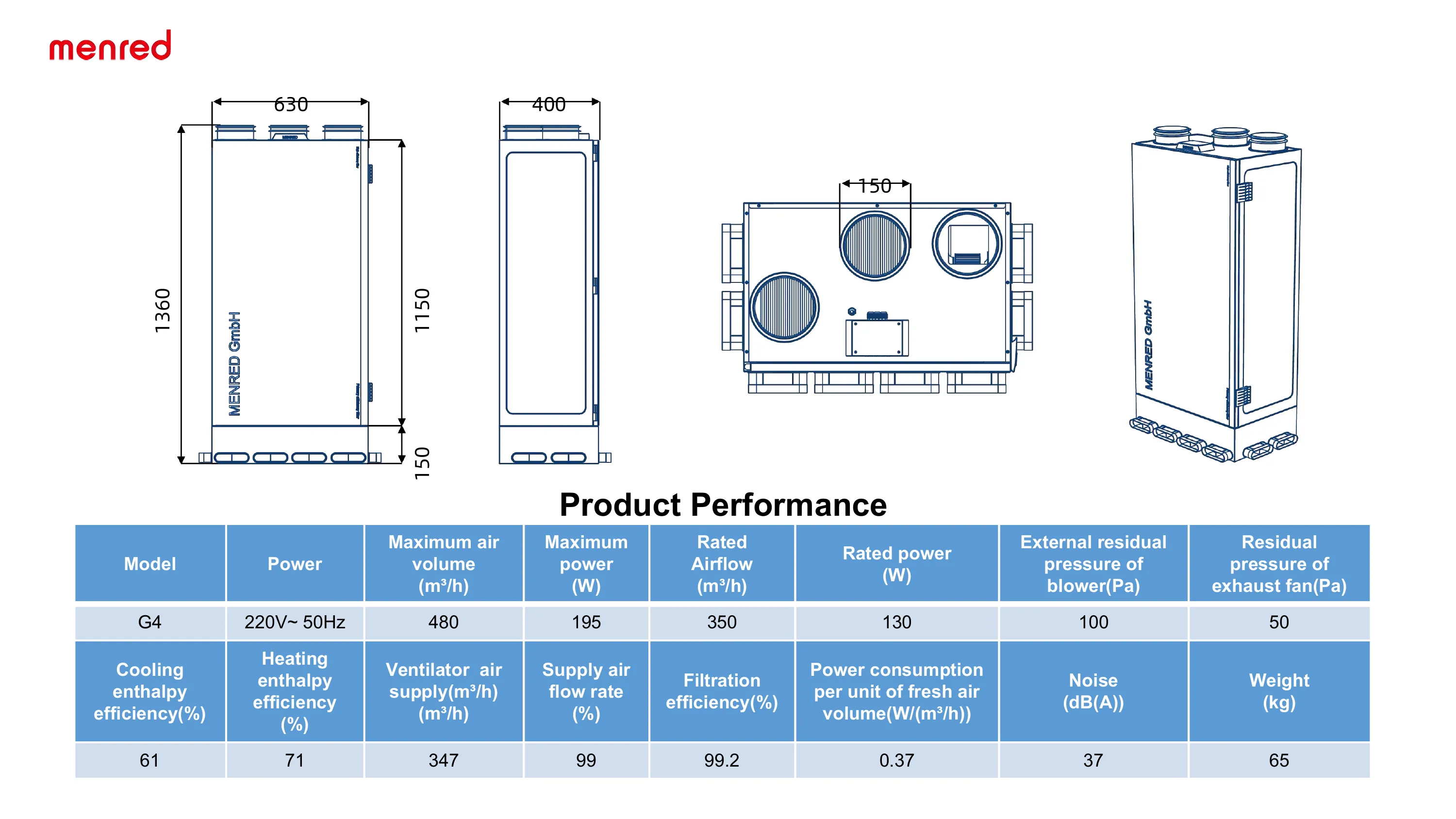
These specifications should be evaluated together with the project’s required airflow, duct pressure, filtration requirement, climate and maintenance plan.
Product performance should always be confirmed against the latest technical datasheet and applicable test conditions before project selection.
Conclusion
Airtightness is essential for improving building energy performance, but airtight buildings cannot depend on accidental leakage for fresh air.
The EPA’s findings highlight the concern: people spend most of their time indoors, some pollutant concentrations can exceed outdoor levels, and energy-efficient construction without adequate mechanical ventilation may contribute to higher indoor pollutant concentrations.
Energy recovery ventilators address this challenge by combining three functions:
- Controlled outdoor-air ventilation
- Balanced supply and exhaust airflow
- Recovery of energy from conditioned exhaust air
For modern low-energy buildings, the relevant question is no longer whether airtightness or ventilation should take priority.
Both are necessary.
A high-performance building should control where air enters, how it is filtered, how much is supplied and how much energy is recovered before stale air leaves the building.
Looking for a Reliable Ventilation Solution?
MENRED provides intelligent ventilation systems and OEM solutions for residential and light-commercial applications.
Get a Free Quote